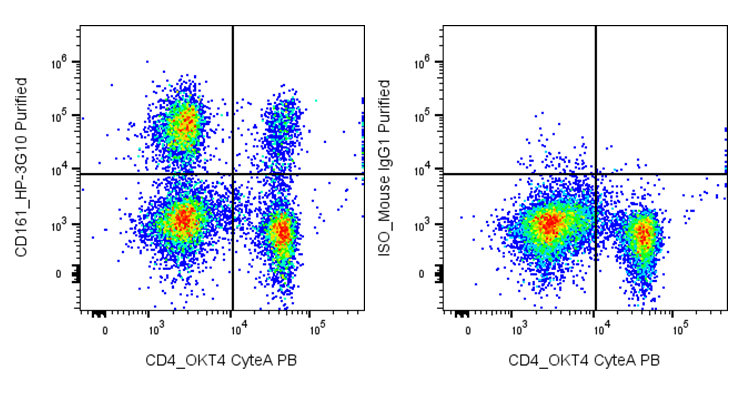
| Cat # | Size | Price | Quantity | |
|---|---|---|---|---|
| 114701 | 25 μg | $55 | ||
| 114702 | 100 μg | $110 |
| Clone | HP-3G10 |
|---|---|
| Application | Flow Cytometry |
| Reactivity | Human |
| Format | Purified |
| Target Name | CD161, NKR-P1A, KLRB1 |
| Isotype | Mouse IgG1 |
| Antibody Type | Monoclonal |
| Regulatory Status | RUO |
| Formulation | Phosphate-buffered solution, pH 7.2, containing 0.09% sodium azide |
| Protein Concentration | 0.5 mg/mL |
| Storage&Handling | The antibody solution should be stored between 2°C and 8°C |
| Recommended Usage | For flow cytometric staining, it is recommended to use less than 0.2 ug of this reagent per 0.5-1.0 million cells in a 100 µL volume. Optimal reagent performance should be determined by titration for each specific application |
| Isotype Controls | 301401 |
| Antibody Family | Human Antibodies |
| Research Areas | NK cells, MAIT cells, Th17 cells, Inflammation |
| See All Formats | Clone HP-3G10 |
CD161, also known as KLRB1 (killer cell lectin-like receptor subfamily B member 1), is a C-type lectin receptor expressed on natural killer (NK) cells, subsets of T cells—including mucosal-associated invariant T (MAIT) cells—and some Th17 cells. It plays a role in modulating immune responses, particularly in balancing activation and inhibition during immune surveillance and inflammation.
Structurally, CD161 is a type II transmembrane protein with a short N-terminal cytoplasmic domain, a single transmembrane region, and an extracellular C-type lectin-like domain responsible for ligand binding. Unlike classical lectins, it does not bind carbohydrates in a calcium-dependent manner but instead recognizes protein ligands.
The primary ligand for CD161 is LLT1 (lectin-like transcript 1, CLEC2D), which is expressed on activated immune cells such as B cells, dendritic cells, and some tumor cells. Interaction between CD161 and LLT1 generally delivers inhibitory signals that can dampen NK and T-cell cytotoxicity and cytokine production, although context-dependent activating effects have also been reported.
In disease, CD161 is implicated in autoimmune disorders, infectious diseases, and cancer. Its expression marks IL-17–producing T cells involved in inflammatory pathology. In tumors, CD161–LLT1 interactions may contribute to immune evasion. Therapeutically, targeting this pathway is under investigation to enhance anti-tumor immunity or modulate inflammatory responses.
Have a product or application question? Consult our FAQs or contact us.