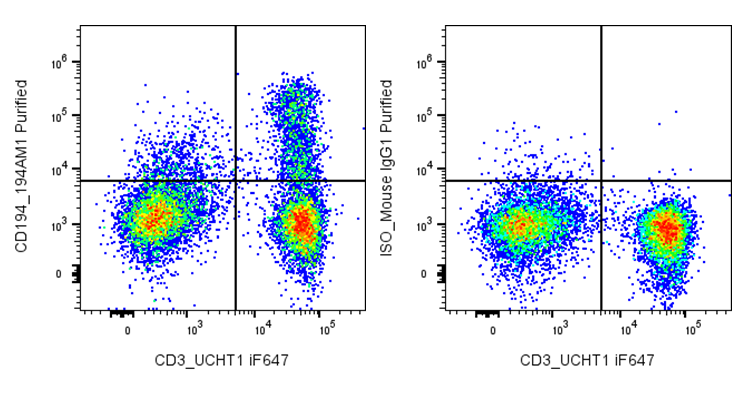
| Cat # | Size | Price | Quantity | |
|---|---|---|---|---|
| 114601 | 25 μg | $90 | ||
| 114602 | 100 μg | $190 |
| Clone | 194AM1 |
|---|---|
| Application | Flow Cytometry |
| Reactivity | Human |
| Format | Purified |
| Target Name | CD194, CCR4, CKR4, ChemR13, K5-5, CMKBR4, ChemR13, CC-CKR-4 |
| Isotype | Mouse IgG1 |
| Antibody Type | Monoclonal |
| Regulatory Status | RUO |
| Formulation | Phosphate-buffered solution, pH 7.2, containing 0.09% sodium azide |
| Protein Concentration | 0.5 mg/mL |
| Storage & Handling | The antibody solution should be stored between 2°C and 8°C |
| Recommended Usage | For flow cytometric staining, it is recommended to use less than 0.2 ug of this reagent per 0.5-1.0 million cells in a 100 µL volume. Optimal reagent performance should be determined by titration for each specific application |
| See All Formats | Clone 194AM1 |
Human CCR4 (C-C chemokine receptor 4) is a G protein–coupled receptor primarily expressed on subsets of T lymphocytes, including Th2 cells and regulatory T cells (Tregs). It plays a key role in directing immune cell trafficking to sites of inflammation, particularly in skin and mucosal tissues. CCR4 contributes to immune surveillance and regulation by guiding lymphocyte migration in response to chemokine gradients.
Structurally, CCR4 is a seven-transmembrane domain receptor typical of the GPCR family, with an extracellular N-terminus involved in ligand binding and an intracellular C-terminus that mediates signal transduction through G proteins. Upon ligand binding, CCR4 activates downstream signaling pathways that regulate cytoskeletal rearrangement, cell migration, and survival.
The principal ligands for CCR4 are the chemokines CCL17 (TARC) and CCL22 (MDC), which are produced by dendritic cells, macrophages, and epithelial cells. These interactions promote recruitment of CCR4-expressing T cells to inflamed tissues.
In disease, CCR4 is implicated in allergic conditions, autoimmune disorders, and cancer. It is highly expressed in certain T-cell malignancies, such as adult T-cell leukemia/lymphoma (ATLL) and cutaneous T-cell lymphoma (CTCL), where it supports tumor cell migration and immune evasion. Therapeutically, CCR4 is a validated target, with monoclonal antibodies like mogamulizumab used to deplete CCR4-positive malignant and regulatory T cells, enhancing anti-tumor immunity.
Mouse IgG1 Isotype Control Antibody
Anti-human CD194 (CCR4) Antibody TDS
Have a product or application question? Consult our FAQs or contact us.