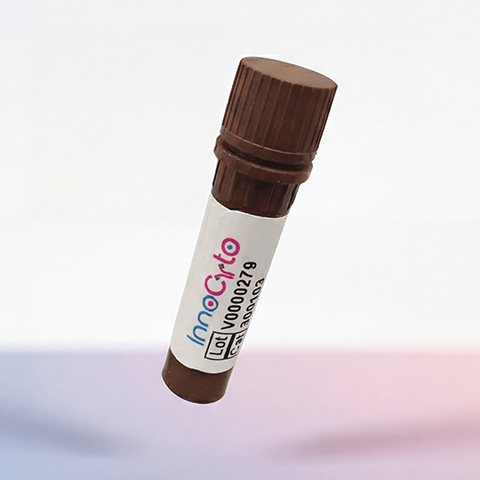
| Cat # | Size | Price | Quantity | |
|---|---|---|---|---|
| 503901 | 1 mg | $250 | ||
| 503902 | 5 mg | $600 | ||
| 503903 | 20 mg | $1800 |
| Clone | Muromonab |
|---|---|
| Application | Flow cytometry, animal model study |
| Host Species | Mammalian cells |
| Reactivity | Human |
| Format | Liquid |
| Product Description | Muromonab Biosimilar, CD3 Monoclonal Antibody |
| Isotype | Human IgG2 |
| Regulatory Status | RUO |
| Clonality | Recombinant |
| Immunogen | Human CD3 |
| Species specificity | Human |
| Purity | >95% by reducing SDS-PAGE |
| Grade | In vivo |
| Storage Conditions | 4ºC |
| Maximal Shelf Life | 12 months |
| Synonyms | CD3e, CD3 epsilon |
| RRID | AB_3739315 |
| Target Name | CD3, T3, CD3ε |
| Antibody Type | Recombinant |
| Research Areas | T cells, T cell Activation, Adaptive Immunity |
| See All Formats | Clone Muromonab |
Muromonab, also known as OKT3, is a murine-derived monoclonal antibody belonging to the immunoglobulin G2a (IgG2a) subclass. It was the first monoclonal antibody developed to specifically target the human CD3 epsilon (CD3ε) subunit—a component of the T-cell receptor (TCR)–CD3 complex located on the surface of T lymphocytes. Structurally, Muromonab is a full-length IgG molecule with a molecular weight of approximately 150 kilodaltons (kDa). It is composed of two identical heavy chains and two identical light chains, linked by interchain disulfide bonds, forming the typical Y-shaped configuration characteristic of immunoglobulins. Each heavy chain contains variable (VH) and constant (CH) domains, while each light chain includes variable (VL) and constant (CL) domains. The molecule is produced by hybridoma technology using murine B-lymphocytes fused with myeloma cells, ensuring high-yield monoclonal antibody production.
The antigen-binding regions of Muromonab are located within the complementarity-determining regions (CDRs) of its VH and VL domains. These CDR loops form the antibody’s paratope, which engages the CD3ε epitope through a network of hydrogen bonds and hydrophobic interactions with nanomolar affinity. The CD3ε subunit plays a critical role in signal transduction following T-cell receptor engagement with peptide–major histocompatibility complex (MHC) molecules. By binding to CD3, Muromonab perturbs TCR–CD3 complex organization, blocking antigen recognition and interrupting downstream signaling cascades involving phosphorylation of ITAMs (immunoreceptor tyrosine-based activation motifs) and activation of intracellular kinases such as Lck and ZAP-70. This interference leads to functional modulation of T-cell activation in experimental systems.
The Fc (fragment crystallizable) region of the IgG2a isotype confers structural stability and can engage Fc gamma receptors (FcγRs), allowing potential secondary immune effects such as antibody-dependent cellular cytotoxicity (ADCC). Overall, Muromonab exemplifies early monoclonal antibody engineering, integrating murine epitope specificity with well-defined IgG architecture to probe receptor-mediated signaling and immune cell regulation mechanisms in molecular immunology research.
Anti-Human CD3 (Muromonab Biosimilar) TDS
Anti-Human CD4 Antibody, Clone 004AB
iF488 Anti-Human CD4 Antibody, Clone OKT4-Rec
iF647 Anti-Human CD4 Antibody, Clone OKT4-Rec
PE Anti-Human CD4 Antibody, Clone RPA-T4
Biotin Human CD3 Protein (C-Fc-Avi)
Anti-Human CD3 Antibody, Clone Hit3a
iF700 Anti-Human CD3 Antibody, Clone Hit3a
iF488 Anti-Human CD3 Antibody, Clone OKT3
Have a product or application question? Consult our FAQs or contact us.