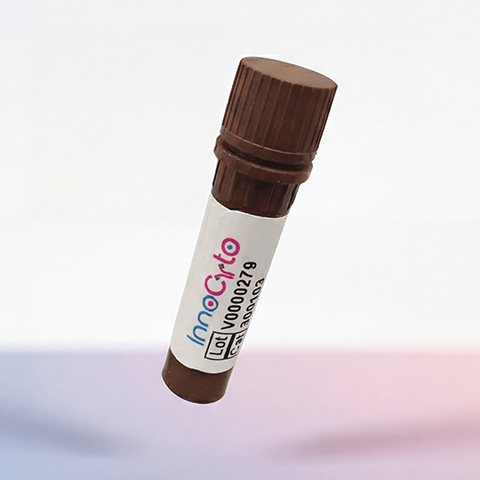
| Cat # | Size | Price | Quantity | |
|---|---|---|---|---|
| 505101 | 2 mg | $500 | ||
| 505102 | 10 mg | $1250 |
| Clone | Ranibizumab |
|---|---|
| Application | Flow cytometry, animal model study |
| Host Species | Mammalian cells |
| Reactivity | Human |
| Format | Liquid |
| Product Description | Anti-Human VEGF (Fab) (Ranibizumab Biosimilar) |
| Isotype | Human IgG1 |
| Regulatory Status | RUO |
| Clonality | Recombinant |
| Immunogen | Human VEGF |
| Species specificity | Human |
| Purity | >95% by reducing SDS-PAGE |
| Grade | In vivo |
| Storage Conditions | 4ºC |
| Maximal Shelf Life | 12 months |
| Synonyms | VEGF-A |
| RRID | AB_3739327 |
| Target Name | Vascular endothelial growth factor, VEGF-A, VEGFA, VEGF |
| Antibody Type | Recombinant |
| Research Areas | Cytokines, Angiogenesis, Hypoxia |
| See All Formats | Clone Ranibizumab |
Ranibizumab is a recombinant humanized monoclonal antibody fragment (Fab) designed to specifically bind and neutralize vascular endothelial growth factor A (VEGF-A). Structurally, it is a single antigen-binding fragment derived from the same parent murine antibody as bevacizumab but lacks the Fc (fragment crystallizable) region, which distinguishes it from full-length immunoglobulin G (IgG) antibodies. The absence of the Fc domain results in a smaller, monovalent molecule with a molecular weight of approximately 48 kilodaltons (kDa).
The molecular structure of Ranibizumab comprises a variable heavy (VH) domain and a variable light (VL) domain connected to their respective constant regions (CH1 and CL). Together, these domains form a single high-affinity antigen-binding site, with complementarity-determining regions (CDRs) mediating specific binding to VEGF-A isoforms, including VEGF121, VEGF165, and VEGF189. The CDRs establish strong non-covalent interactions with residues located within the heparin-binding domain of VEGF-A. This high-affinity binding occurs in the picomolar range, effectively sequestering VEGF-A and preventing it from binding to its cell surface receptors, VEGFR-1 (Flt-1) and VEGFR-2 (KDR). The disruption of VEGF-receptor interactions inhibits downstream receptor dimerization and phosphorylation, blocking intracellular signaling pathways such as MAPK and PI3K-AKT that mediate vascular permeability, endothelial proliferation, and angiogenesis in experimental systems.
Functionally, Ranibizumab’s small molecular size enhances tissue penetration and allows rapid diffusion through extracellular matrices, making it suitable for localized VEGF inhibition at target sites. Although it lacks the Fc fragment, and thus cannot engage Fc gamma receptors (FcγRs) or activate complement, it retains high structural stability and solubility due to optimized domain folding and disulfide bridge formation. Overall, Ranibizumab exemplifies precision antibody engineering, combining molecular compactness and epitope specificity to investigate VEGF-mediated signaling and angiogenic processes in molecular biology research.
Anti-Human VEGF (Fab) (Ranibizumab Biosimilar) TDS
Anti-Human VEGF (Aflibercept Biosimilar), Clone Aflibercept
Anti-Human VEGF (Bevacizumab Biosimilar), Clone Bevacizumab
In Vivo Star Anti-Mouse VEGF Antibody, Clone B20-4.1.1
Anti-Human VEGF-A (Brolucizumab Biosimilar), Clone Brolucizumab
In Vivo Star Anti-Mouse CD279 (PD1) / VEGF-A Bispecific Antibody, Clone RMP1-14 / B20-4.1.1
In Vivo Star Anti-Mouse CD274 (PD-L1) / VEGF-A Bispecific Antibody, Clone 10F.9G2 / B20-4.1.1
Have a product or application question? Consult our FAQs or contact us.