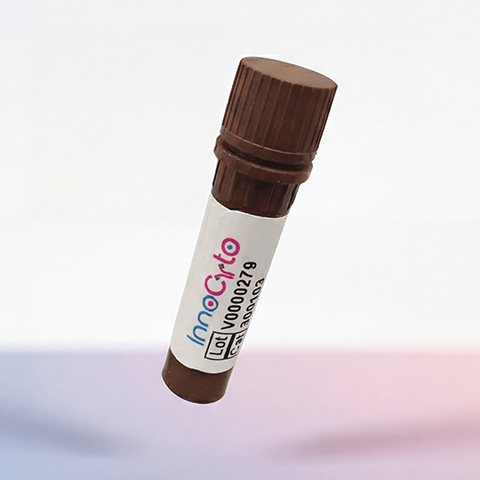
| Cat # | Size | Price | Quantity | |
|---|---|---|---|---|
| 505001 | 1 mg | $190 | ||
| 505002 | 5 mg | $590 | ||
| 505003 | 20 mg | $1390 |
| Clone | Ramucirumab |
|---|---|
| Application | Flow cytometry, animal model study |
| Host Species | Mammalian cells |
| Reactivity | Human |
| Format | Liquid |
| Product Description | Anti-Human VEGFR-2 (Ramucirumab Biosimilar) |
| Isotype | Human IgG1 |
| Regulatory Status | RUO |
| Clonality | Recombinant |
| Immunogen | Human VEGFR2 |
| Species specificity | Human |
| Purity | >95% by reducing SDS-PAGE |
| Grade | In vivo |
| Storage Conditions | 4ºC |
| Maximal Shelf Life | 12 months |
| RRID | AB_3739326 |
| Target Name | VEGFR2, VEGF-R2, KDR, Tyrosin kinase growth factor receptor, homolog of FLK1 (FLK1), VEGFR |
| Antibody Type | Recombinant |
| Research Areas | Endothelial cells, Angiogenesis, Inflammation, Hematopoietic Stem cells, Cancer Marker |
| See All Formats | Clone Ramucirumab |
Ramucirumab is a fully human monoclonal antibody that belongs to the immunoglobulin G1 (IgG1) subclass and is engineered to bind with high specificity to vascular endothelial growth factor receptor 2 (VEGFR-2), also known as kinase insert domain receptor (KDR). Structurally, Ramucirumab is a glycoprotein with an approximate molecular weight of 147 kilodaltons (kDa). The molecule consists of two identical heavy chains and two identical light chains interconnected by disulfide bonds, forming the canonical Y-shaped antibody configuration typical of IgG molecules. It is produced using recombinant DNA technology in mammalian expression systems such as Chinese Hamster Ovary (CHO) cells to ensure proper folding, disulfide linkage formation, and glycosylation compatible with human proteins.
The variable regions (VH and VL) of Ramucirumab define its antigen-binding site, composed of complementarity-determining regions (CDRs) that mediate specific, high-affinity recognition of the extracellular domain of VEGFR-2. This region corresponds to the receptor’s ligand-binding site for vascular endothelial growth factor A (VEGF-A), VEGF-C, and VEGF-D. By binding to this epitope, Ramucirumab sterically blocks the interaction between VEGFR-2 and its ligands, preventing receptor dimerization and autophosphorylation events required for downstream signaling activation. This inhibition disrupts intracellular pathways, primarily the MAPK (mitogen-activated protein kinase) and PI3K-AKT cascades, that regulate endothelial cell proliferation, migration, and survival in experimental systems investigating angiogenic control.
The Fc (fragment crystallizable) region of Ramucirumab is derived from human IgG1, providing structural stability and an extended half-life through neonatal Fc receptor (FcRn)–mediated recycling. It also permits limited engagement with Fc gamma receptors (FcγRs), enabling potential antibody-dependent cellular cytotoxicity (ADCC) under certain conditions, though this is not the primary mechanism. Overall, Ramucirumab exemplifies rational antibody design, combining precise receptor targeting, stable IgG architecture, and defined signaling blockade, to model ligand–receptor regulation and angiogenic signaling mechanisms at the molecular level.
Anti-Human VEGFR-2 (Ramucirumab Biosimilar) TDS
In Vivo Star Anti-Mouse CD279 (PD1) / VEGFR-2 Bispecific Antibody, Clone RMP1-14 / DC101
In Vivo Star Anti-Mouse CD274 (PD-L1) / VEGFR-2 Bispecific Antibody, Clone 10F.9G2 / DC101
Have a product or application question? Consult our FAQs or contact us.