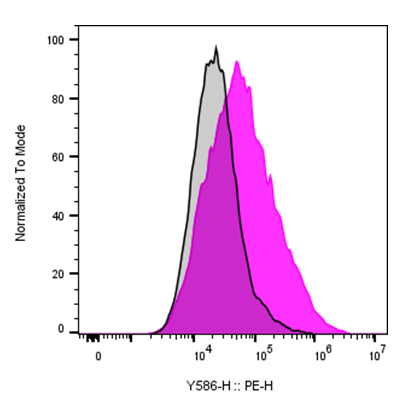
| Cat # | Size | Price | Quantity | |
|---|---|---|---|---|
| 204801 | 100 μg | $55 | ||
| 204802 | 500 μg | $115 |
| Clone | GL-1 |
|---|---|
| Application | Flow Cytometry, IHC-F, IP, ICC |
| Reactivity | Mouse |
| Format | Purified |
| Target Name | CD86, B7-2, Ly-58, B70 |
| Isotype | Rat IgG2a |
| Antibody Type | Monoclonal |
| Regulatory Status | RUO |
| Formulation | Phosphate-buffered solution, pH 7.2, containing 0.09% sodium azide |
| Protein Concentration | 0.5 mg/mL |
| Storage&Handling | The antibody solution should be stored between 2°C and 8°C |
| Recommended Usage | For flow cytometric staining, it is recommended to use less than 0.5 ug of this reagent per 0.5-1.0 million cells in a 100 µL volume. Optimal reagent performance should be determined by titration for each specific application. |
| Research Areas | Dendritic cells, monocytes, macrophages, Activated B cells, Activated T cells, Co-stimulation, Immune Checkpoints, Cancer Marker, Autoimmunity |
| See All Formats | Clone GL-1 |
Mouse CD86 (also known as B7-2) is a co-stimulatory surface protein expressed primarily on antigen-presenting cells (APCs), including dendritic cells, macrophages, and B cells. It plays a central role in T cell activation by providing the necessary second signal required for full T cell priming, complementing antigen recognition through the T cell receptor. Upon immune stimulation, CD86 expression is rapidly upregulated, enabling efficient initiation of adaptive immune responses and regulation of T cell differentiation.
Structurally, CD86 is a type I transmembrane glycoprotein and a member of the immunoglobulin superfamily. It contains extracellular IgV- and IgC-like domains responsible for ligand binding, a single-pass transmembrane region, and a short cytoplasmic tail lacking intrinsic enzymatic activity. Despite this, CD86 can participate in intracellular signaling through association with adaptor molecules and membrane microdomains, influencing APC activation and cytokine production.
The primary ligands of CD86 are CD28 and CTLA-4 (CD152), both expressed on T cells. Interaction with CD28 delivers a positive co-stimulatory signal that promotes T cell proliferation, cytokine secretion, and survival, while binding to CTLA-4 transmits inhibitory signals that dampen immune responses and maintain tolerance.
CD86 is implicated in autoimmune diseases, transplant rejection, and chronic inflammation due to dysregulated co-stimulation. It is also involved in tumor immune evasion by influencing T cell activation thresholds.
Therapeutically, the CD86 pathway is targeted by agents such as CTLA-4-Ig fusion proteins (e.g., abatacept) that block CD28-mediated co-stimulation, providing benefit in autoimmune diseases. Modulating CD86 activity also holds promise in cancer immunotherapy and transplant tolerance strategies.
Rat IgG2a Isotype Control Antibody
Have a product or application question? Consult our FAQs or contact us.