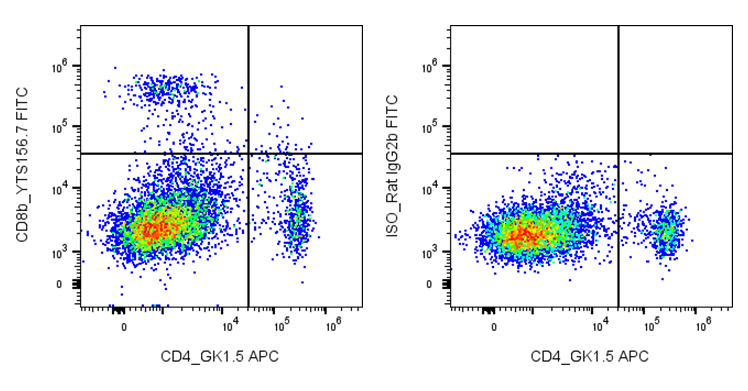
| Cat # | Size | Price | Quantity | |
|---|---|---|---|---|
| 204707 | 25 tests | $25 | ||
| 204708 | 100 tests | $50 |
| Clone | YTS156.7.7 |
|---|---|
| Application | Flow Cytometry, IHC-F |
| Reactivity | Mouse |
| Format | FITC |
| Target Name | CD8b, Lyt-3, Ly-3 |
| Isotype | Rat IgG2b |
| Antibody Type | Monoclonal |
| Regulatory Status | RUO |
| Formulation | Phosphate-buffered solution, pH 7.2, containing 0.09% sodium azide and 0.2% (w/v) BSA |
| Protein Concentration | Supplied at a lot-specific concentration. |
| Storage&Handling | The antibody solution should be stored undiluted between 2°C and 8°C, and protected from prolonged exposure to light. Do not freeze. |
| Recommended Usage | For flow cytometric staining, it is recommended to use 5 µL of this reagent per 0.5-1.0 million cells in a 100 µL volume. Optimal reagent performance should be determined by titration for each specific application. FITC has an excitation max at 493 nm and an emission max at 525 nm. |
| Excitation Laser | Blue Laser (488 nm) |
| Research Areas | T cells, T cell Activation, Adaptive Immunity |
| See All Formats | Clone YTS156.7.7 |
Mouse CD8β (CD8b) is a glycoprotein expressed primarily on cytotoxic T lymphocytes, where it forms a heterodimer with CD8α to create the CD8 co-receptor complex. This complex plays a crucial role in T-cell receptor (TCR) signaling by binding to major histocompatibility complex class I (MHC I) molecules on antigen-presenting cells. CD8β enhances the sensitivity and specificity of antigen recognition, supporting effective cytotoxic responses against infected or malignant cells.
Structurally, CD8β is a type I transmembrane protein with an extracellular immunoglobulin-like domain, a single transmembrane region, and a short cytoplasmic tail. It pairs with CD8α through disulfide bonding to form the CD8αβ heterodimer, which is the predominant form on conventional T cells. The cytoplasmic domain contributes to signaling by associating indirectly with intracellular kinases such as Lck via CD8α.
The primary ligand for the CD8αβ complex is MHC class I, which presents peptide antigens to CD8+ T cells. CD8β itself contributes to stabilizing this interaction and optimizing TCR engagement rather than independently binding ligands.
In disease models, CD8β-expressing T cells are central to antiviral and anti-tumor immunity but can also contribute to immunopathology and autoimmunity when dysregulated. Therapeutically, CD8β is not directly targeted but is important in T-cell–based immunotherapies, including adoptive T-cell transfer and vaccine strategies, where robust CD8+ T-cell responses are desired.
FITC Rat IgG2b Isotype Control
FITC Anti-mouse CD8b Antibody TDS
Have a product or application question? Consult our FAQs or contact us.