| Cat # | Size | Price | Quantity | |
|---|---|---|---|---|
| 604001 | 25 ug | $145 | ||
| 604002 | 100 ug | $325 |
| Application | Flow Cytometry |
|---|---|
| Format | Liquid, iFlour 488 |
| Expression Host | E.coli |
| Target Name | Pro-aerolysin, FLAER, aerolysin, AER |
| Species | Aeromonas hydrophila |
| Sources | Recombinant Pro-aerolysin (Ala24-Arg453) with N-Met and C-terminus His tag is expressed in E.coli system. This protein is conjugated to iFlour 488. |
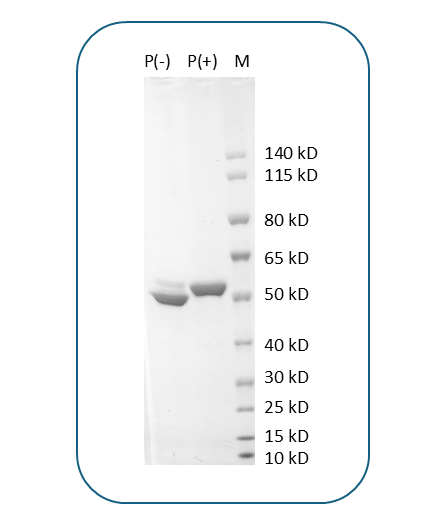
| Molecular Weight | This protein has a predicted molecular weight of 53 kDa. Under DTT-reducing conditions, the protein migrates at approximately 55 kDa on SDS-PAGE prior to conjugation. |
| Affinity Tag | C-His |
| Purity | >95% based on SDS-PAGE under reducing condition |
| Regulatory Status | RUO |
| Formulation | 1xPBS/0.05%NaN3/0.2%BSA |
| Endotoxin level | Not tested |
| Protein Concentration | 25µg size is bottled at 0.3mg/mL concentration. 100 µg size is supplied at a lot-specific concentration. |
| Storage and Handling | Briefly centrifuge the vial upon receipt. An unopened vial may be stored at 2–8°C for up to six months. |
| Research Areas | Paroxysmal Nocturnal Hemoglobinuria |
Pro-aerolysin is the inactive precursor of aerolysin, a pore-forming toxin produced by the bacterium Aeromonas hydrophila. It has been engineered to be non-toxic. FLAER is a fluorescently labeled derivative of pro-aerolysin and serves as a valuable reagent for detecting cells that express GPI-anchored proteins.
Have a product or application question? Consult our FAQs or contact us.