| Cat # | Size | Price | Quantity | |
|---|---|---|---|---|
| 600005 | 25 ug | $245 | ||
| 600006 | 100 ug | $595 |
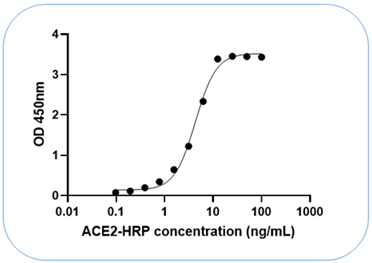
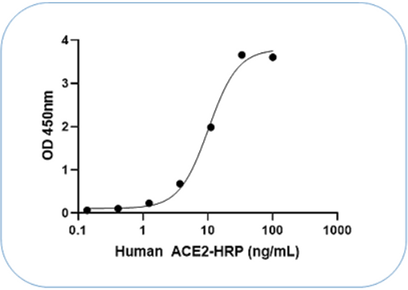
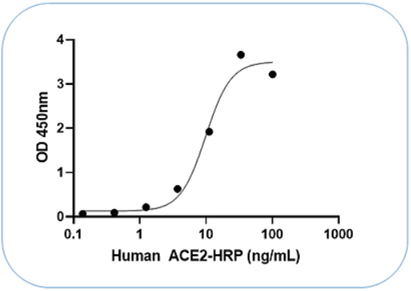
| Application | ELISA |
|---|---|
| Format | Liquid, HRP conjugated |
| Expression Host | HEK293 |
| Target Name | ACE2, ACE-2, Angiotensin I converting Enzyme 2, ACEH |
| Species | Human |
| Accession Number | Q9BYF1 |
| Sources | Human ACE2 protein (Gln18-Ser740) with N-terminus His tag is expressed in HEK293 cells and conjugated to HRP. |
| Molecular Weight | This protein has a predicted molecular weight of 86.5 kDa. Under DTT-reducing conditions, the protein migrates at approximately 90-110 kDa on SDS-PAGE. |
| Affinity Tag | N-His |
| Regulatory Status | RUO |
| Formulation | 1xPBS buffer, pH7.4, 0.22 µm filtered, with 50% Stabilizer |
| Endotoxin level | Not tested |
| Protein Concentration | 25µg size is bottled at 0.1mg/mL concentration. 100 µg size is supplied at a lot-specific concentration. |
| Storage and Handling | Quick spin the vial after receiving. Unopened vial can be stored at 4°C for six months. |
| Research Areas | SARS-CoV-2, Infectious Diseases |
Angiotensin-converting enzyme 2 (ACE2) is a type I transmembrane zinc metalloprotease with about 60% homology to ACE, consisting of 805 amino acids including a signal peptide, catalytic domain, membrane anchor, and cytoplasmic tail. ACE2 regulates the renin-angiotensin system by converting angiotensin I to angiotensin 1-9 and angiotensin II to the vasodilator angiotensin 1-7, thus counteracting vasoconstriction and playing a key role in cardiovascular and renal function. ACE2 also serves as the functional receptor for human coronaviruses SARS-CoV, SARS-CoV-2, and HCoV-NL63, facilitating viral entry. Its expression is high in lung, heart, kidney, intestine, testis, and vascular cells. Beyond cardiovascular regulation, ACE2 is involved in respiratory disease pathogenesis, including acute respiratory distress syndrome, and has been linked to diabetes and hypertension. Additionally, its homolog collectrin is implicated in amino acid transport and genetic disorders like Hartnup disease.
HRP Human ACE-2 Protein (N-His) TDS
Biotin Human ACE-2 Protein (N-His)
HRP Human ACE-2 Protein (N-His)
Human ACE-2 Protein (C-His-Avi)
Biotin Human ACE-2 Protein (C-His-Avi)
Have a product or application question? Consult our FAQs or contact us.