| Cat # | Size | Price | Quantity | |
|---|---|---|---|---|
| 600301 | 25 ug | $145 | ||
| 600302 | 100 ug | $295 |
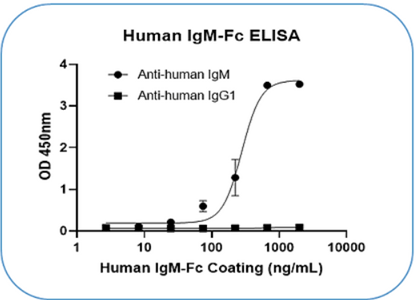
| Application | ELISA |
|---|---|
| Format | Liquid, Purified |
| Expression Host | HEK293 |
| Target Name | Human IgM-Fc protein |
| Species | Human |
| Accession Number | P01871 |
| Sources | Human IgM-Fc (Val105-Gly434) protein with C-terminus His tag is expressed in HEK293 cells. |
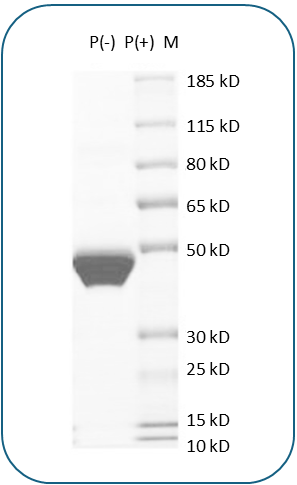
| Molecular Weight | This protein has a predicted molecular weight of 37.8 kDa. Under DTT-reducing conditions, the protein migrates at approximately 40-45 kDa on SDS-PAGE. |
| Affinity Tag | None |
| Purity | >95% based on SDS-PAGE under reducing condition |
| Regulatory Status | RUO |
| Formulation | 1xPBS buffer, pH7.4, 0.22 µm filtered |
| Endotoxin level | Not tested |
| Protein Concentration | 25µg size is bottled at 0.2mg/mL concentration. 100 µg size is supplied at a lot-specific concentration. |
| Storage and Handling | Briefly centrifuge the vial upon receipt. An unopened vial can be stored at 4°C for up to 2 weeks, or at -20°C or below for up to six months. The protein may be further diluted to 0.1 mg/mL using 0.22 µm-filtered PBS buffer (pH 7.4). For long-term storage, the diluted stock solution should be aliquoted and stored at ≤ –70°C to minimize freeze-thaw cycles. If additional dilution is required, carrier proteins such as FBS or BSA should be added to maintain protein stability. |
Fc fragments consist of the carboxy-terminal halves of both immunoglobulin heavy chains connected by disulfide bonds, forming the constant region responsible for antibody effector functions. These functions include complement fixation, binding to Fc receptors on immune cells (such as CD16, CD32, and CD64), and mediating placental transport of antibodies. The Fc region plays a critical role in immune defense by triggering processes like opsonization, antibody-dependent cellular cytotoxicity (ADCC), and inflammation. Additionally, proteins like Protein A and Protein G, found on certain bacteria, specifically bind to the Fc region and are widely used in biotechnology for antibody purification. Recombinant Fc fragments also have potential therapeutic applications as anti-inflammatory agents in autoimmune diseases.
Biotin donkey Anti-human IgM, Clone Poly005
HRP donkey Anti-human IgM, Clone Poly005
Have a product or application question? Consult our FAQs or contact us.