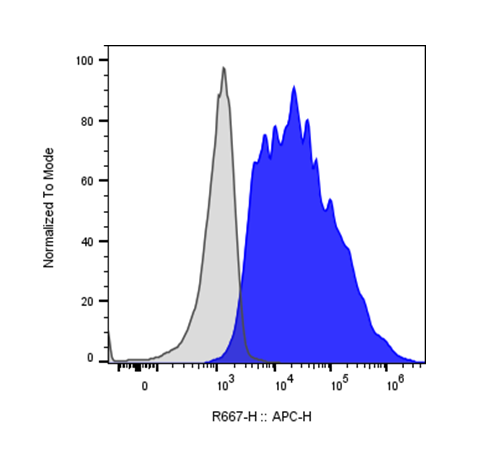
| Cat # | Size | Price | Quantity | |
|---|---|---|---|---|
| 108003 | 25 tests | $120 | ||
| 108004 | 100 tests | $240 |
| Clone | 4B4-1 |
|---|---|
| Application | Flow Cytometry |
| Reactivity | Human |
| Format | iF647 |
| Target Name | CD137, 4-1BB, ILA, TNFRSF9 |
| Isotype | Mouse IgG1 |
| Antibody Type | Monoclonal |
| Regulatory Status | RUO |
| Formulation | Phosphate-buffered solution, pH 7.2, containing 0.09% sodium azide and 0.2% (w/v) BSA |
| Protein Concentration | Supplied at a lot-specific concentration. |
| Storage&Handling | The antibody solution should be stored undiluted between 2°C and 8°C, and protected from prolonged exposure to light. Do not freeze. |
| Recommended Usage | For flow cytometric staining, it is recommended to use 5 µL of this reagent per 0.5-1.0 million cells in a 100 µL volume. Optimal reagent performance should be determined by titration for each specific application. iF647 has an excitation max at 656 nm and an emission max at 670 nm. |
| Excitation Laser | Red Laser (633 nm) |
| RRID | AB_3738814 |
| Research Areas | Activated T cells, Activated NK cells, Activated Endothelial cells, Cancer Immunology, Autoimmunity, Inflammation, Co-stimulation |
| See All Formats | Clone 4B4-1 |
CD137 is a 39 kDa type I transmembrane protein and a member of the Tumor Necrosis Factor Receptor (TNFR) superfamily. It is expressed on activated T cells, NKT cells, and NK cells, where it functions as a co-stimulatory molecule that promotes T cell proliferation, survival, and monocyte activation through its interaction with 4-1BB ligand. CD137 plays a key role in anti-tumor immunity. Agonistic anti-CD137 antibodies enhance tumor-specific CD8⁺ T cell responses, increase NK and dendritic cell function, and improve antibody-dependent cellular cytotoxicity (ADCC) when used with tumor-targeting monoclonal antibodies. Its expression can be upregulated on NK cells after CD16 ligation, although its effect on NK cell cytotoxicity can vary between human and murine systems. Overall, CD137 is an important immunomodulatory target in cancer immunotherapy.
iF647 Mouse IgG1 Isotype Control Antibody
iF647 Anti-Human CD137 (4-1BB) Antibody TDS
Human 4-1BBL/TNFSF9 Protein (N-Fc)
Human 4-1BBL/TNFSF9 Protein (N-His)
Human CD137/4-1BB/TNFRSF9 Protein (C-His-Avi)
Biotin Human CD137/4-1BB/TNFRSF9 Protein (C-His-Avi)
Human CD137/4-1BB/TNFRSF9 Protein (C-His)
PE Human CD137/4-1BB/TNFRSF9 Protein (C-His)
APC Human CD137/4-1BB/TNFRSF9 Protein (C-His)
Human CD137/4-1BB/TNFRSF9 Protein (C-Fc-Avi)
Have a product or application question? Consult our FAQs or contact us.