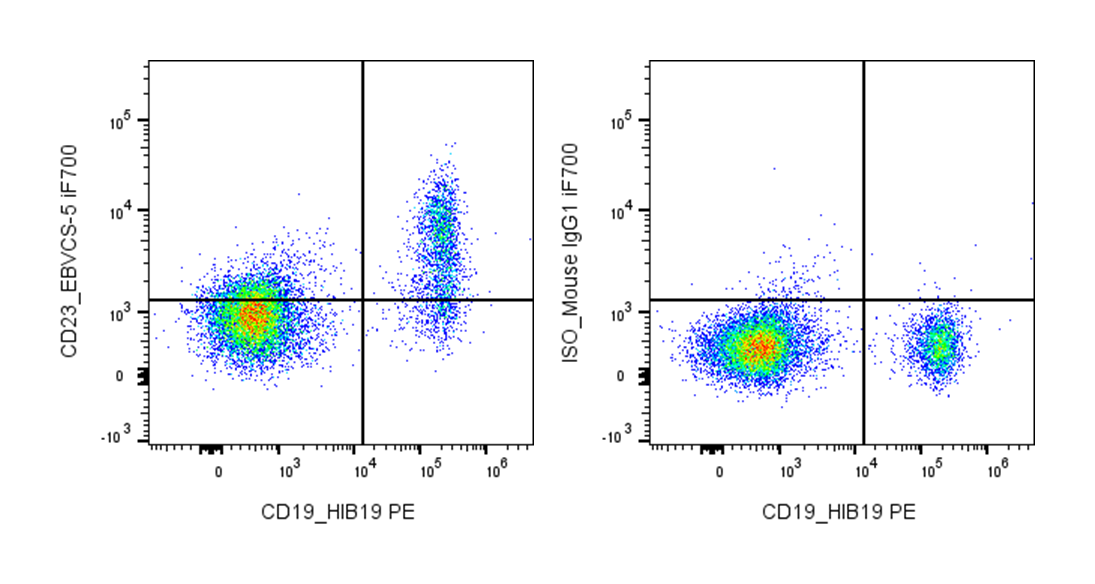
| Cat # | Size | Price | Quantity | |
|---|---|---|---|---|
| 112909 | 25 tests | $105 | ||
| 112910 | 100 tests | $250 |
| Clone | EBVCS-5 |
|---|---|
| Application | Flow Cytometry |
| Reactivity | Human |
| Format | iF700 |
| Target Name | CD23, Leu-20, IgE Fc Receptor, BLAST-2, Low affinity IgE receptor |
| Isotype | Mouse IgG1 |
| Antibody Type | Monoclonal |
| Regulatory Status | RUO |
| Formulation | Phosphate-buffered solution, pH 7.2, containing 0.09% sodium azide and 0.2% (w/v) BSA |
| Protein Concentration | Supplied at a lot-specific concentration. |
| Storage&Handling | The antibody solution should be stored undiluted between 2°C and 8°C, and protected from prolonged exposure to light. Do not freeze. |
| Recommended Usage | For flow cytometric staining, it is recommended to use 5 µL of this reagent per 0.5-1.0 million cells in a 100 µL volume. Optimal reagent performance should be determined by titration for each specific application. iF700 has an excitation max at 690 nm and an emission max at 710 nm. |
| Excitation Laser | Red Laser (633 nm) |
| Research Areas | B cells, Platelets, follicular Dendritic cells, Macrophages, Eosinophils, Cancer Marker, Allergy |
| See All Formats | Clone EBVCS-5 |
CD23, also known as Fc epsilon receptor II (FcεRII), is a low-affinity receptor for immunoglobulin E (IgE) primarily expressed on B cells, as well as on other immune cells such as monocytes, dendritic cells, and some epithelial cells. It plays a key role in regulating IgE-mediated immune responses, including allergic inflammation and antigen presentation. CD23 helps control IgE levels by facilitating the uptake and processing of IgE-bound antigens, thereby influencing both humoral and cellular immunity.
Structurally, CD23 is a type II transmembrane protein belonging to the C-type lectin family. It consists of a short N-terminal cytoplasmic tail, a single transmembrane domain, and a large extracellular region containing a lectin-like head domain responsible for IgE binding. CD23 can also be cleaved by proteases to generate soluble forms (sCD23), which retain biological activity and can modulate immune responses at a distance.
The primary ligand of CD23 is IgE, to which it binds with low affinity compared to the high-affinity FcεRI receptor. CD23 also interacts with other molecules such as CD21 (complement receptor 2) and integrins, contributing to cell adhesion, signaling, and regulation of B cell growth and differentiation. These interactions help coordinate immune responses, particularly in allergic and parasitic conditions.
In disease, CD23 is strongly associated with allergic disorders such as asthma, allergic rhinitis, and atopic dermatitis, where dysregulated IgE responses play a central role. Elevated levels of soluble CD23 are often observed in these conditions. Additionally, CD23 is a diagnostic marker in certain hematologic malignancies, including chronic lymphocytic leukemia (CLL), where it is highly expressed on malignant B cells.
Therapeutically, CD23 is a target for interventions aimed at modulating IgE-mediated diseases. Strategies include blocking CD23-IgE interactions to reduce allergic inflammation and targeting CD23-expressing cells in malignancies. Ongoing research continues to explore CD23-directed therapies for both allergic and oncologic indications.
iF700 Mouse IgG1 Isotype Control Antibody
iF700 Anti-human CD23 Antibody TDS
Have a product or application question? Consult our FAQs or contact us.