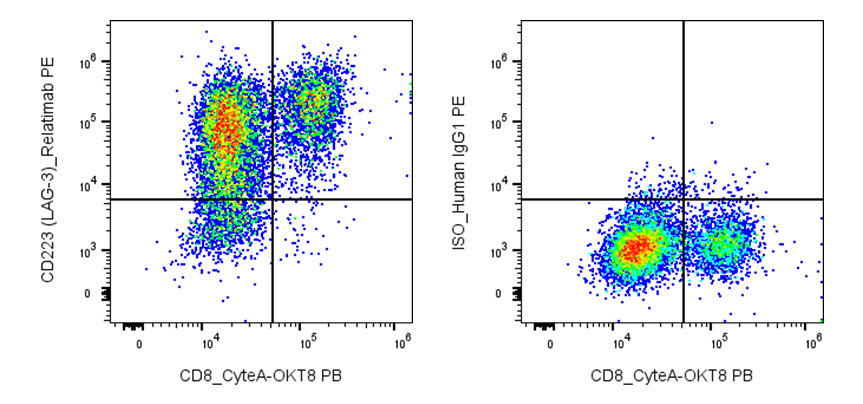
| Cat # | Size | Price | Quantity | |
|---|---|---|---|---|
| 117203 | 25 tests | $110 |
| Clone | Relatlimab |
|---|---|
| Application | Flow Cytometry |
| Reactivity | Human |
| Format | PE |
| Target Name | CD223, LAG3, LAG-3, lymphocyte-activation gene-3 |
| Isotype | Human IgG4 |
| Antibody Type | Monoclonal |
| Regulatory Status | RUO |
| Formulation | Phosphate-buffered solution, pH 7.2, containing 0.09% sodium azide and 0.2% (w/v) BSA |
| Protein Concentration | Supplied at a lot-specific concentration. |
| Storage&Handling | The antibody solution should be stored undiluted between 2°C and 8°C, and protected from prolonged exposure to light. Do not freeze. |
| Recommended Usage | For flow cytometric staining, it is recommended to use 5 µL of this reagent per 0.5-1.0 million cells in a 100 µL volume. Optimal reagent performance should be determined by titration for each specific application. PE has an excitation max at 565 nm and an emission max at 575 nm. |
| Excitation Laser | Blue Laser (488 nm) Green/Yellow laser (532/561nm) |
| Research Areas | T cells, Tregs, Activated NK cells, Immune Checkpoints, Exhaustion |
| See All Formats | Clone Relatlimab |
Human CD223 (LAG-3) is an inhibitory immune checkpoint receptor expressed on activated T cells, regulatory T cells, NK cells, and dendritic cells. It is a type I transmembrane glycoprotein of the immunoglobulin superfamily with four extracellular Ig-like domains, a single transmembrane region, and a cytoplasmic tail containing inhibitory motifs including KIEELE. CD223 is upregulated after T-cell receptor activation and limits immune responses to maintain peripheral tolerance. It binds MHC class II with high affinity, competing with CD4, and also interacts with fibrinogen-like protein 1 (FGL1), contributing to immune regulation in tumor environments and immune modulation.
CD223 plays a key role in immune evasion in cancer and chronic infection by promoting T-cell exhaustion and reducing cytokine production, proliferation, and cytotoxic function. It is frequently co-expressed with PD-1 on exhausted tumor-infiltrating lymphocytes. While important for preventing autoimmunity, sustained signaling suppresses anti-tumor immunity and supports tumor progression. It is also upregulated during chronic viral infection due to persistent antigen stimulation making it a major target in immunotherapy strategies and ongoing clinical research efforts.
Relatimab is an investigational monoclonal antibody targeting CD223 (LAG-3) that blocks ligand binding to restore T-cell activity. By inhibiting interactions with MHC-II and FGL1, it reduces T-cell exhaustion and enhances anti-tumor responses. It is studied in oncology, often combined with PD-1/PD-L1 inhibitors to improve immune activation and clinical outcomes in cancer therapy within current immunotherapy development strategies and trials ongoing.
PE Human IgG4 Isotype Control Antibody
PE Anti-Human CD223 (LAG-3) Antibody TDS
Have a product or application question? Consult our FAQs or contact us.