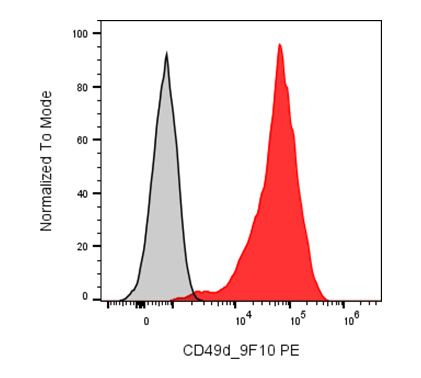
| Cat # | Size | Price | Quantity | |
|---|---|---|---|---|
| 114407 | 25 tests | $85 | ||
| 114408 | 100 tests | $195 |
| Clone | 9F10 |
|---|---|
| Application | Flow Cytometry |
| Reactivity | Human |
| Format | PE |
| Target Name | CD49d, VLA-4 α, Integrin α4, ITGA4 |
| Isotype | Mouse IgG1 |
| Antibody Type | Monoclonal |
| Regulatory Status | RUO |
| Formulation | Phosphate-buffered solution, pH 7.2, containing 0.09% sodium azide and 0.2% (w/v) BSA |
| Protein Concentration | Supplied at a lot-specific concentration. |
| Storage & Handling | The antibody solution should be stored undiluted between 2°C and 8°C, and protected from prolonged exposure to light. Do not freeze. |
| Recommended Usage | For flow cytometric staining, it is recommended to use 5 µL of this reagent per 0.5-1.0 million cells in a 100 µL volume. Optimal reagent performance should be determined by titration for each specific application. PE has an excitation max at 565 nm and an emission max at 575 nm. |
| Excitation Laser | Blue Laser (488 nm) Green/Yellow laser (532/561nm) |
| See All Formats | Clone 9F10 |
CD49d, also known as integrin α4, is a cell surface adhesion molecule expressed on leukocytes including lymphocytes, monocytes, and eosinophils. It plays a central role in immune cell trafficking by mediating adhesion to vascular endothelium and facilitating transmigration into tissues during immune surveillance and inflammation. CD49d pairs with β1 (CD29) or β7 integrins to form the heterodimers α4β1 (VLA-4) and α4β7, each with distinct tissue-homing functions.
Structurally, CD49d is a type I transmembrane glycoprotein with a large extracellular domain responsible for ligand binding, a single-pass transmembrane region, and a קצר cytoplasmic tail that links to intracellular signaling and cytoskeletal machinery. Its principal ligands include VCAM-1 (vascular cell adhesion molecule-1) and fibronectin for α4β1, and MAdCAM-1 (mucosal addressin cell adhesion molecule-1) for α4β7, enabling tissue-specific adhesion and migration.
In disease, CD49d contributes to chronic inflammation and autoimmune disorders such as multiple sclerosis and inflammatory bowel disease by promoting leukocyte infiltration into target tissues. It is also implicated in cancer, particularly in leukemias, where high CD49d expression correlates with enhanced survival and poor prognosis.
Therapeutically, CD49d is a validated target. Monoclonal antibodies such as natalizumab block α4 integrins to reduce immune cell migration, providing clinical benefit in multiple sclerosis and Crohn’s disease. Ongoing strategies aim to refine targeting while minimizing immunosuppression-related risks.
PE Mouse IgG1 Isotype Control Antibody
PE Anti-Human CD49d Antibody TDS
Have a product or application question? Consult our FAQs or contact us.