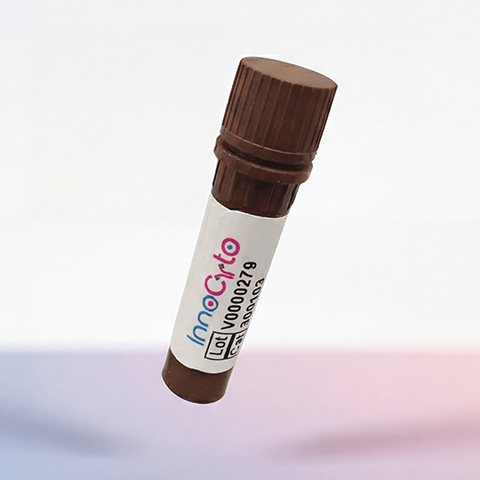
| Cat # | Size | Price | Quantity | |
|---|---|---|---|---|
| 504801 | 1 mg | $190 | ||
| 504802 | 5 mg | $590 | ||
| 504803 | 20 mg | $1800 |
| Clone | Pertuzumab |
|---|---|
| Application | Flow cytometry, animal model study |
| Host Species | Mammalian cells |
| Reactivity | Human |
| Format | Liquid |
| Product Description | Anti-Human HER2 (Pertuzumab Biosimilar) |
| Isotype | Human IgG1 |
| Regulatory Status | RUO |
| Clonality | Recombinant |
| Immunogen | Human ErbB-2 / Her2 |
| Species specificity | Human |
| Purity | >95% by reducing SDS-PAGE |
| Grade | In vivo |
| Storage Conditions | 4ºC |
| Maximal Shelf Life | 12 months |
| Synonyms | ErbB2 |
| RRID | AB_3739324 |
| Target Name | HER2, HER-2, ERBB2, CD340, neu, MLN19, NEU, NGL, TKR1 |
| Antibody Type | Recombinant |
| Research Areas | Mesenchymal Stem Cells, Embryogenesis, Cancer Marker, Cancer Immunology |
| See All Formats | Clone Pertuzumab |
Pertuzumab is a recombinant humanized monoclonal antibody of the immunoglobulin G1 kappa (IgG1κ) subclass, engineered to specifically target the extracellular domain II (also known as the dimerization domain) of the human epidermal growth factor receptor 2 (HER2, or ErbB2). Structurally, Pertuzumab is a glycoprotein with a molecular mass of approximately 148 kilodaltons (kDa). The molecule is composed of two identical heavy chains and two identical light chains, linked by interchain disulfide bonds to form the characteristic Y-shaped structure typical of IgG antibodies. It is produced in mammalian cell expression systems such as Chinese Hamster Ovary (CHO) cells, which enable proper folding, glycosylation, and molecular stability.
The variable regions of Pertuzumab’s heavy (VH) and light (VL) chains contain complementarity-determining regions (CDRs) that determine the antibody’s high specificity and affinity for the domain II region of HER2. This domain is critical for receptor dimerization with other members of the ErbB family, such as HER3 and EGFR (HER1). By binding to this domain, Pertuzumab sterically hinders the heterodimerization process that normally activates HER2-mediated intracellular signaling pathways. These pathways include the RAS-RAF-MEK-ERK and PI3K-AKT cascades, which regulate gene expression, cellular growth, and survival in experimental systems. In doing so, Pertuzumab acts at the molecular level to disrupt ligand-dependent receptor crosstalk and downstream phosphorylation cascades.
The Fc (fragment crystallizable) region of Pertuzumab, derived from human IgG1, contributes to structural integrity, pharmacokinetic stability, and interaction with the neonatal Fc receptor (FcRn), allowing antibody recycling and prolonged circulatory half-life. Additionally, the Fc region can engage Fc gamma receptors (FcγRs), enabling effector mechanisms such as antibody-dependent cellular cytotoxicity (ADCC) in vitro.
Anti-Human HER2 (Pertuzumab Biosimilar) TDS
Human HER2 (CD340) Protein (C-His-Avi)
Biotin Human HER2 (CD340) Protein (C-His-Avi)
Human HER2 (CD340) Protein (C-His)
Anti-Human HER2 (Trastuzumab Biosimilar), Clone Trastuzumab
Anti-Human HER2 (Trastuzumab Biosimilar), Clone Trastuzumab
PE Human HER2 (CD340) Protein (C-His)
Have a product or application question? Consult our FAQs or contact us.