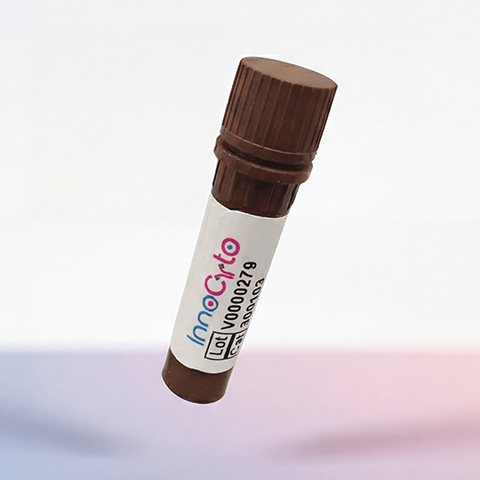
| Cat # | Size | Price | Quantity | |
|---|---|---|---|---|
| 504701 | 1 mg | $190 | ||
| 504702 | 5 mg | $590 | ||
| 504703 | 20 mg | $1100 |
| Clone | Pembrolizumab |
|---|---|
| Application | Flow cytometry, animal model study |
| Host Species | Mammalian cells |
| Reactivity | Human |
| Format | Liquid |
| Product Description | Anti-Human PD-1 (Pembrolizumab Biosimilar) |
| Isotype | Human IgG4 |
| Regulatory Status | RUO |
| Clonality | Recombinant |
| Immunogen | Human PD1 |
| Species specificity | Human |
| Purity | >95% by reducing SDS-PAGE |
| Grade | In vivo |
| Storage Conditions | 4ºC |
| Maximal Shelf Life | 12 months |
| Synonyms | CD279 |
| RRID | AB_3739323 |
| Target Name | PD1, PD-1, PDCD1, CD279, SLEB2 |
| Antibody Type | Recombinant |
| Research Areas | Immune Checkpoints, Activated T cells, Cancer Immunology, Tregs, Tfh cells, Activated B cells |
| See All Formats | Clone Pembrolizumab |
Pembrolizumab is a fully humanized monoclonal antibody of the immunoglobulin G4 kappa (IgG4κ) subclass engineered to specifically bind to the programmed death-1 (PD-1, also known as CD279) receptor expressed on activated T cells. Structurally, Pembrolizumab is a glycoprotein with a molecular weight of approximately 149 kilodaltons (kDa). The molecule consists of two identical heavy chains and two identical light chains joined by disulfide bonds, forming the characteristic Y-shaped architecture typical of immunoglobulins. Each heavy chain is composed of one variable (VH) and three constant (CH1-CH3) domains, while each light chain contains one variable (VL) and one constant (CL) domain. It is produced in mammalian expression systems, such as Chinese Hamster Ovary (CHO) cells, to ensure correct folding, glycosylation, and molecular stability.
The variable domains of Pembrolizumab contain complementarity-determining regions (CDRs) that form the antigen-binding sites responsible for recognizing a specific epitope on the PD-1 receptor. These CDRs establish high-affinity, non-covalent interactions with the extracellular domain of PD-1. By occupying the ligand-binding region of PD-1, Pembrolizumab effectively blocks its interaction with programmed death-ligand 1 (PD-L1) and programmed death-ligand 2 (PD-L2). This blockade inhibits the intracellular signaling cascade initiated by PD-1 engagement, which normally leads to suppression of T-cell activation, cytokine production, and proliferation. In experimental systems, this results in enhanced T-cell signaling and immune response regulation.
The Fc (fragment crystallizable) region of Pembrolizumab is derived from the IgG4 isotype and includes an engineered S228P mutation in the hinge region to improve structural integrity by preventing half-antibody exchange. The IgG4 Fc configuration minimizes binding to Fc gamma receptors (FcγRs) and complement component C1q, thus greatly reducing antibody-dependent and complement-mediated cytotoxicity. Overall, Pembrolizumab exemplifies advanced antibody engineering, combining high receptor specificity, precise inhibitory activity, and optimized molecular stability for studies of immune checkpoint regulation and T-cell receptor–ligand dynamics.
Anti-Human PD1 (Pembrolizumab Biosimilar) TDS
Anti-Mouse CD274 (PD-L1) Antibody, Clone 10F.9G2
Biotin Anti-Mouse CD274 (PD-L1) Antibody, Clone 10F.9G2
Anti-Human PD-L1 (Atezolizumab Biosimilar), Clone Atezolizuma
Anti-Human PD-L1 (Avelumab Biosimilar), Clone Avelumab
Human PD1 (CD279) Protein (C-His-Avi)
Biotin Human PD1 (CD279) Protein (C-His-Avi)
Human PD1 (CD279) Protein (C-His)
Anti-Human PD1 (Camrelizumab Biosimilar), Clone Camrelizumab
Anti-Human PD1 (Cemiplimab Biosimilar), Clone Cemiplimab
Anti-Human PD1 (Nivolumab Biosimilar), Clone Nivolumab
Have a product or application question? Consult our FAQs or contact us.