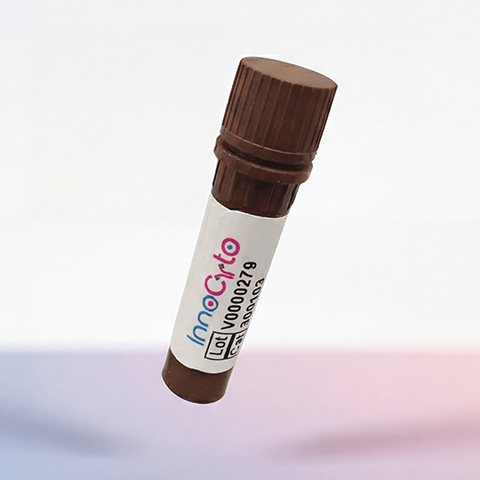
| Cat # | Size | Price | Quantity | |
|---|---|---|---|---|
| 500401 | 1 mg | $500 | ||
| 500402 | 5 mg | $1200 | ||
| 500403 | 20 mg | $3900 |
| Clone | Aflibercept |
|---|---|
| Application | Neutralization, Intracellular Flow cytometry, animal model study |
| Host Species | Mammalian cells |
| Reactivity | Human |
| Format | Liquid |
| Product Description | Anti-Human VEGF (Aflibercept Biosimilar) |
| Isotype | Human IgG1-Fc |
| Regulatory Status | RUO |
| Clonality | Recombinant |
| Species specificity | Human |
| Purity | >95% by reducing SDS-PAGE |
| Grade | In vivo |
| Min Sample Size | 1 mg |
| Storage Conditions | 4ºC |
| Maximal Shelf Life | 12 months |
| Synonyms | VEGFR, VEGFR1, VEGFR2 |
| Target Name | VEGF |
| Research Areas | Cytokines, Angiogenesis, Hypoxia |
| See All Formats | Clone Aflibercept |
Aflibercept is a recombinant fusion protein specifically engineered to act as a decoy receptor for vascular endothelial growth factors (VEGFs). Structurally, the molecule combines the ligand-binding domains of two distinct human receptors, VEGFR-1 (Flt-1) and VEGFR-2 (KDR), fused to the Fc portion of human immunoglobulin G1 (IgG1). More precisely, Aflibercept contains the extracellular domain 2 of VEGFR-1 and domain 3 of VEGFR-2, which together form a high-affinity binding site for VEGF ligands. The resultant fusion protein has a molecular mass of approximately 115 kilodaltons (kDa) and is produced in mammalian expression systems such as Chinese Hamster Ovary (CHO) cells to ensure proper folding, disulfide bonding, and glycosylation.
The Fc region of Aflibercept serves several critical structural and functional purposes. It provides molecular stability, confers dimerization through disulfide bridges to form a Y-shaped homodimer, and extends the molecule's circulatory half-life via interactions with neonatal Fc receptors (FcRn). The fusion of the VEGF-binding domains to this Fc backbone effectively produces a hybrid receptor that retains the natural ligand-binding specificity of VEGFR molecules while gaining the pharmacokinetic benefits typical of antibodies. Each Aflibercept dimer can bind multiple molecules of VEGF, acting as a soluble trap with high binding affinity in the picomolar range.
Functionally, Aflibercept acts as a potent VEGF antagonist by sequestering VEGF-A, VEGF-B, and placental growth factor (PlGF) before these ligands can interact with their receptors on endothelial cells. By intercepting VEGF signaling, the molecule effectively prevents receptor dimerization and downstream activation of signaling pathways such as MAPK and PI3K-AKT, which are involved in endothelial cell proliferation, survival, and permeability. This molecular sequestration mechanism makes Aflibercept an important biological model for studying angiogenesis regulation, receptor-ligand affinity optimization, and engineered protein-receptor interactions in molecular biology and biochemistry.
Anti-Human VEGF (Aflibercept Biosimilar) TDS
Anti-Human VEGF (Bevacizumab Biosimilar), Clone Bevacizumab
Anti-Human VEGF (Fab) (Ranibizumab Biosimilar), Clone Ranibizumab
In Vivo Star Anti-Mouse VEGF Antibody, Clone B20-4.1.1
Anti-Human VEGF-A (Brolucizumab Biosimilar), Clone Brolucizumab
In Vivo Star Anti-Mouse CD279 (PD1) / VEGF-A Bispecific Antibody, Clone RMP1-14 / B20-4.1.1
In Vivo Star Anti-Mouse CD274 (PD-L1) / VEGF-A Bispecific Antibody, Clone 10F.9G2 / B20-4.1.1
Have a product or application question? Consult our FAQs or contact us.