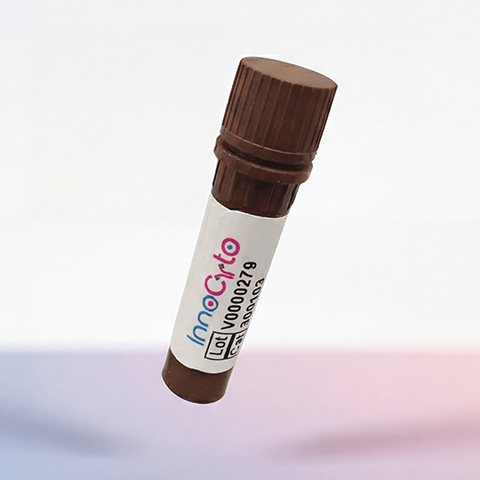
| Cat # | Size | Price | Quantity | |
|---|---|---|---|---|
| 500901 | 1 mg | $125 | ||
| 500902 | 5 mg | $400 | ||
| 500903 | 20 mg | $960 |
| Clone | Bevacizumab |
|---|---|
| Application | Neutralization, Intracellular Flow cytometry, animal model study |
| Host Species | Mammalian cells |
| Reactivity | Human |
| Format | Liquid |
| Product Description | Bevacizumab Biosimilar, Human VEGF Monoclonal Antibody |
| Isotype | Human IgG1 |
| Regulatory Status | RUO |
| Clonality | Recombinant |
| Immunogen | Human VEGF |
| Species specificity | Human |
| Purity | >95% by reducing SDS-PAGE |
| Grade | In vivo |
| Min Sample Size | 1 mg |
| Storage Conditions | 4ºC |
| Maximal Shelf Life | 12 months |
| Synonyms | VEGF-A |
| Target Name | VEGF |
| Research Areas | Cytokines, Angiogenesis, Hypoxia |
| See All Formats | Clone Bevacizumab |
Bevacizumab is a recombinant humanized monoclonal antibody belonging to the immunoglobulin G1 (IgG1) subclass. It is designed to specifically bind to vascular endothelial growth factor A (VEGF-A), a critical signaling glycoprotein that regulates angiogenesis and vascular permeability. Structurally, Bevacizumab is composed of two identical heavy chains and two identical light chains, each linked by disulfide bonds to form a Y-shaped configuration typical of IgG antibodies, with a total molecular weight of approximately 149 kilodaltons (kDa).
The variable regions contain three complementarity-determining regions (CDRs) within each chain, forming the paratope that interacts with specific epitopes on human VEGF-A. This binding is mediated through hydrogen bonding, van der Waals forces, and electrostatic interactions that confer Bevacizumab high affinity and specificity, typically in the nanomolar range. The antigen-binding process is highly selective, preventing VEGF-A from engaging its native receptors, VEGFR-1 (Flt-1) and VEGFR-2 (KDR), located on the surface of endothelial cells. This molecular blockade inhibits receptor dimerization and downstream intracellular signaling cascades, including the MAPK and PI3K-AKT pathways, which are responsible for cellular proliferation, migration, and survival.
The constant (Fc) region of Bevacizumab contributes structural stability and extends the molecule’s circulating half-life through neonatal Fc receptor (FcRn) recycling. It also allows the antibody to maintain dimeric stability under physiological conditions. Bevacizumab’s glycosylation pattern within its Fc domain supports folding and solubility while minimizing undesired immune effector function such as complement activation or antibody-dependent cytotoxicity.
Anti-Human VEGF (Bevacizumab Biosimilar) TDS
Anti-Human VEGF (Aflibercept Biosimilar), Clone Aflibercept
Anti-Human VEGF (Fab) (Ranibizumab Biosimilar), Clone Ranibizumab
In Vivo Star Anti-Mouse VEGF Antibody, Clone B20-4.1.1
Anti-Human VEGF-A (Brolucizumab Biosimilar), Clone Brolucizumab
In Vivo Star Anti-Mouse CD279 (PD1) / VEGF-A Bispecific Antibody, Clone RMP1-14 / B20-4.1.1
In Vivo Star Anti-Mouse CD274 (PD-L1) / VEGF-A Bispecific Antibody, Clone 10F.9G2 / B20-4.1.1
Have a product or application question? Consult our FAQs or contact us.