| Cat # | Size | Price | Quantity | |
|---|---|---|---|---|
| 600501 | 25 ug | $145 | ||
| 600502 | 100 ug | $295 |
| Application | ELISA |
|---|---|
| Format | Liquid, Purified |
| Expression Host | HEK293 |
| Target Name | Hexosaminidase A |
| Species | Human |
| Accession Number | P06865 |
| Sources | Human HexA (Leu23-Thr529) protein with C-terminus His tag is expressed in HEK293 cells. |
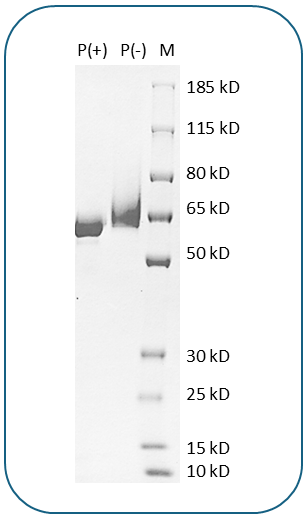
| Molecular Weight | This protein has a predicted molecular weight of 60.2 kDa. Under DTT-reducing conditions, the protein migrates at approximately 65 kDa on SDS-PAGE. |
| Affinity Tag | C-His |
| Purity | >95% based on SDS-PAGE under reducing condition |
| Regulatory Status | RUO |
| Formulation | 1xPBS buffer, pH7.4, 0.22 µm filtered |
| Endotoxin level | Not tested |
| Protein Concentration | 25µg size is bottled at 0.2mg/mL concentration. 100 µg size is supplied at a lot-specific concentration. |
| Storage and Handling | Briefly centrifuge the vial upon receipt. An unopened vial can be stored at 4°C for up to 2 weeks, or at -20°C or below for up to six months. The protein may be further diluted to 0.1 mg/mL using 0.22 µm-filtered PBS, pH 7.4. For long-term storage, the diluted stock solution should be aliquoted and stored at ≤ –70°C to minimize freeze-thaw cycles. If additional dilution is required, carrier proteins such as FBS or BSA should be added to maintain protein stability. |
| Research Areas | Metabolism |
Beta-hexosaminidases are lysosomal enzymes that hydrolyze terminal N-acetyl-D-hexosamine residues from GM2 gangliosides and globo-sphingolipids. They exist in three isoforms: Hex A (αβ), Hex B (ββ), and Hex S (αα), formed by different combinations of α and β subunits encoded by the HEXA and HEXB genes. Recombinant HEXA corresponds to Hex S and cleaves non-reducing end N-acetylgalactosamine residues from dermatan sulfate, chondroitin sulfate, and sulfated glycolipids, and is also active against 4-methylumbelliferyl-N-acetyl-β-D-glucosaminide. Mutations in HEXA cause Tay-Sachs disease, a fatal lysosomal storage disorder marked by GM2 ganglioside accumulation in neurons, typically leading to death by age 4.
Human HexA Protein (C-His, 293 Expressed) TDS
Human HexA Protein (C-His, CHO Expressed)
HexB-P2A/HexA-His Heterodimer Protein
HexA-His/HexB-FLAG Heterodimer Protein
Biotin HexA-His/HexB-FLAG Heterodimer Protein
Have a product or application question? Consult our FAQs or contact us.